How Many Continents Is There In Africa

BSC Insights Admin
September 30, 2026
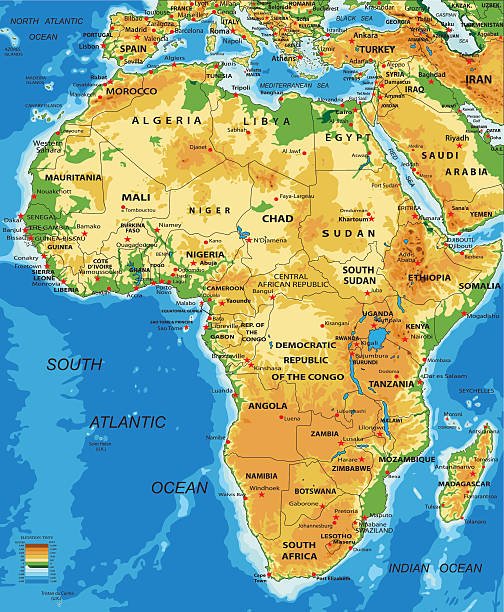
Understanding Africa: A Single, Vast Continent
The question of how many continents is there in Africa often stems from a common misconception, but the straightforward answer is clear: Africa itself is a single, immense continent. It is not a collection of smaller continents; rather, it is one of the seven (or five, depending on the model) universally recognized continents on Earth. This misconception likely arises from Africa's staggering size, incredible diversity, and the sheer number of countries it encompasses, leading some to perceive it as a landmass so vast it must contain multiple continental entities.
As the second-largest continent in the world by both land area and population, Africa covers approximately 30.3 million square kilometers (11.7 million square miles), accounting for about 20% of Earth's landmass. This colossal scale is home to 54 recognized countries, each with its own unique cultures, languages, and histories. Understanding African geography correctly means acknowledging it as a singular, unified landmass with distinct boundaries, not a fragmented collection of separate continents.
Defining a Continent: The Geographical Perspective
To fully grasp why Africa is considered one continent, it's essential to understand what defines a continent. Generally, continents are large, continuous landmasses separated by oceans or distinct geographical features. While there isn't one single, universally agreed-upon definition, key characteristics include:
- Massive Landmass: Continents are incredibly large, unbroken expanses of land.
- Distinct Boundaries: They are typically delineated by oceans, seas, or significant geological features.
- Tectonic Plates: Often, a continent sits on its own tectonic plate, though there can be exceptions (e.g., Eurasia).
- Cultural & Geographical Uniqueness: While diverse, each continent tends to have overarching geographical and often cultural distinctions.
Africa perfectly fits these criteria. It is a massive, unbroken landmass clearly separated from Europe by the Mediterranean Sea and from Asia by the Suez Canal and the Red Sea. Its long coastlines are bounded by the Atlantic Ocean to the west and the Indian Ocean to the east. This clear geographical demarcation reinforces Africa's status as a solitary continent, distinct from all others.
Dispelling the Myth: Why the Confusion About "Continents in Africa"?
The idea of how many continents is there in Africa or that there might be multiple continents within Africa is a common misunderstanding. Several factors contribute to this persistent myth:
-
Immense Size and Scale: As discussed, Africa is enormous. Traveling from one end to another is comparable to crossing entire continents like North America or Europe. This sheer scale can make it feel like an aggregation of smaller landmasses.
-
Vast Diversity: From the arid Sahara Desert in the north to the lush rainforests of the Congo Basin, and from the snow-capped peaks of Mount Kilimanjaro to the expansive savannas, Africa boasts unparalleled ecological and climatic diversity. This natural variety, alongside its over 3,000 distinct ethnic groups and more than 2,000 languages, often leads people to think of its regions as separate entities.
-
Regional Categorization: For organizational and study purposes, Africa is often divided into five distinct regions: North Africa, West Africa, Central Africa, East Africa, and Southern Africa. While these regional classifications are useful for understanding African diversity and specific challenges or characteristics, they are purely geographical or socio-economic distinctions, not separate continents. For example, North Africa shares cultural ties with the Middle East, while Southern Africa has unique biodiversity, but both are unequivocally part of the same continental landmass.
-
Historical Narratives and Colonial Legacy: Historically, Africa was often portrayed in fragmented ways, particularly during colonial periods, which emphasized differences rather than unity. This historical narrative can inadvertently contribute to a perception of disunity or multiple distinct "worlds" within the continent.
It is crucial to remember that despite these contributing factors, Africa remains a single, coherent geographical entity on the global map of continents of the world.
Africa's Staggering Statistics: A Continent of Records
Delving into the numbers solidifies Africa's standing as a single, monumental continent. When exploring the size of Africa, its statistics are truly impressive:
- Land Area: Approximately 30.3 million square kilometers (11.7 million square miles), making it the second largest continent by land area. This is large enough to fit the United States, China, India, Japan, and most of Europe combined within its borders.
- Population: With over 1.4 billion people (as of 2023), Africa is the second most populous continent, hosting about 18% of the world's human population. This population is distributed across numerous vibrant societies.
- Number of Countries: Africa is home to 54 sovereign countries, recognized by the United Nations. This is more than any other continent except Asia, showcasing its political fragmentation within a unified geographical space. Some of the most well-known countries in Africa include Nigeria, Egypt, South Africa, Kenya, and Morocco, each contributing to the continent's rich tapestry.
- Coastline Length: Africa boasts an extensive coastline of approximately 30,500 kilometers (18,950 miles), bordering two major oceans (Atlantic and Indian) and several seas.
- Geographical Extremes: From the world's largest hot desert, the Sahara, to the longest river, the Nile, and the vast Congo Rainforest (the second-largest rainforest in the world), Africa contains incredible extremes. The Great Rift Valley, a massive geological fault system, stretches thousands of kilometers and is a cradle of human evolution.
These figures underscore the immense scale and inherent unity of Africa as a single, diverse continent, not a collection of smaller ones.
The Five Regions of Africa: Unity in Diversity
While Africa is one continent, for easier study and understanding of its vast cultural, environmental, and economic differences, it is commonly divided into five distinct geographical regions. It is critical to reiterate that these are merely regional classifications within the same continent, not separate continents themselves.
North Africa
Comprising countries like Egypt, Libya, Tunisia, Algeria, Morocco, and Sudan, this region is largely characterized by the Sahara Desert and strong historical and cultural ties to the Middle East, particularly through the Arabic language and Islam. The Nile River is a dominant feature, especially in Egypt.
West Africa
Home to nations such as Nigeria, Ghana, Senegal, and Côte d'Ivoire, West Africa is known for its vibrant cultures, diverse ecosystems ranging from savannas to coastal forests, and a rich history of powerful empires. The Niger River is a significant lifeblood for many of these nations.
Central Africa
This region includes countries like the Democratic Republic of Congo, Cameroon, and Angola. It is dominated by the expansive Congo Basin, home to the world's second-largest rainforest and incredible biodiversity. Access can be challenging due to dense forests and river systems.
East Africa
Featuring countries such as Kenya, Tanzania, Ethiopia, and Uganda, East Africa is famous for its stunning wildlife, the Great Rift Valley, and significant archaeological sites related to human origins. It also includes island nations like Madagascar and Comoros.
Southern Africa
Encompassing nations like South Africa, Botswana, Namibia, and Zimbabwe, this region is celebrated for its unique landscapes, from deserts to mountains, and its rich mineral resources. It also boasts diverse cultures and wildlife conservation efforts.
Each of these regions, while distinct, is an integral part of the larger African continent, contributing to its overall character and global importance. They are illustrative of African diversity, not evidence of multiple continental landmasses.
Africa's Global Significance and Unique Contributions
Beyond its geographical status, Africa holds immense global significance. It is the birthplace of humanity, with archaeological evidence pointing to the earliest human ancestors originating here. Its rich history includes powerful ancient civilizations like the Pharaohs of Egypt, the Empire of Mali, and the Kingdom of Axum, which shaped global trade and knowledge for centuries.
Today, Africa is a continent of immense potential and dynamism. Its youthful population, abundant natural resources, and growing economies are poised to play an increasingly vital role on the world stage. Addressing the question of how many continents is there in Africa correctly helps to foster a more accurate and respectful understanding of this complex and vibrant landmass, moving away from outdated or erroneous perceptions.
Understanding that Africa is a single, unified continent is the first step towards appreciating its incredible contributions to global culture, science, and economy. From its groundbreaking advancements in renewable energy to its thriving arts scenes and its leadership in biodiversity conservation, Africa is a continent that commands respect and requires a nuanced understanding, free from geographical misconceptions.
Conclusion: Africa – One Continent, Boundless Diversity
In conclusion, to directly answer the query how many continents is there in Africa, the unequivocal truth is that Africa is one single, unified continent. It is not home to multiple continents, nor is it itself divided into smaller continental entities. The misconception often arises from its extraordinary size, its incredible ecological and cultural diversity, and the useful, but sometimes misleading, regional classifications such as North, West, Central, East, and Southern Africa. These are merely internal divisions within the larger, coherent continental landmass.
Africa stands as the second-largest and second-most populous continent, a geological marvel bordered by vast oceans and seas. Its 54 countries contribute to a rich tapestry of over a billion people, thousands of languages, and countless cultures. By recognizing Africa as a singular continent, we embrace a more accurate geographical understanding and pave the way for a deeper appreciation of its profound history, vibrant present, and promising future on the global stage. Dispelling the myth of multiple continents within Africa is crucial for fostering informed discussions about this vital part of our world.
Enjoyed this read?
Share it with your friends and colleagues.